A Brief Interview with Fumio Ohashi
Founder & Chief Designer of BAlabo

When did you first become interested in audio?
Around the time I was in junior high school. My love of music led me
to my interest in audio and I started building my own amp.
What did you study in school, where did you attend, and what was your
first job after graduating?
I studied electronic engineering at Hosei University in Tokyo. I got
my first job at Nagaoka, the well-known manufacturer of phono
cartridges.
What companies have you worked for and what kinds of projects have
you been involved with over the years?
At Nagaoka, my job was to develop phono cartridges and head amps. I
left Nagaoka after about eight years to work for Luxman. Around that
time, CDs started to appear in the market, and with this transition,
I made a career move so I could work with amplifiers. I've been
developing analog amps ever since.
What year did you start BAlabo and why did you decide to do it?
I started BAlabo in March, 2002 just after being promoted chief
engineer with Luxman. Although I was advancing in my career, I was
posed with a dilemma. I wanted to produce the best possible products
using the latest technology that was available. A 'Sky is the limit'
approach.
But large consumer electronics companies must always find the equilibrium point that balances what they are capable of making with what the customer wants and can afford. Because of this disparity, my ideas did not always play well in the boardroom. To an engineer like me, this meant continual compromise on performance and features in order to hit a target sweet spot in the marketplace. Products were certainly good enough to satisfy customers, but they were not nearly the best that could be made if price were no object.
Since I had just turned 50, I had this strong desire to build something that would be the culmination of my 30-plus years of engineering experience. I wanted to 'reach for the stars' and make the best products in the world. That's why I started BAlabo.
What do you consider to be your three most innovative design aspects
of the BAlabo line?
There are numerous technical achievements so it's hard to put my
finger on just three ideas. I suppose as a general theme, the use of
the post-attenuation scheme coupled with higher internal voltages is
at the core of our innovative edge. There are several other elements
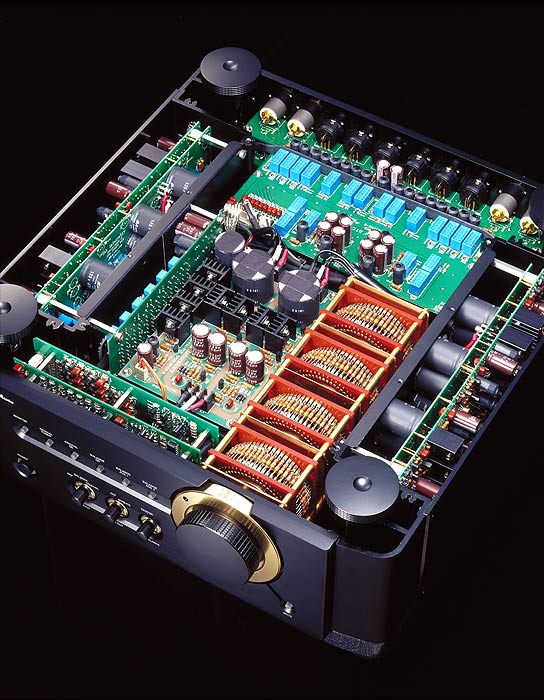
that support these design aspects like our extraordinary volume
control and specially designed relays - all of these things work
together.
Secondly, in terms of innovation, I'd have to count our specially designed capacitors as contributing greatly to the BAlabo sound. Several of our caps took over one year to develop.
Finally, I would have to say that I am particularly proud of the Control-amp's exterior design. We made an extra effort to sculpt the front panel into a work of art. But apart from the visual and tactile aspects of operation, there is also an overarching theme we have incorporated for those who take moment to look more closely.
The front panel design theme is that of a solar system and beyond. The large golden volume dial corresponds to the sun and each of the lit input switches to the planets. The image evoked is a straight line of planets - alluding to a planetary alignment. The phrase 'Planetary Alignment' comes from a famous old hypothesis (probably from astrologers and psychics) that planets lining up in a straight line will cause a massive earthquakes and tidal waves on planet Earth. The illumination around the power switch represents the rings of Saturn. The anti-vibration material has a black field with white specks, expressing the stars of the cosmos.
So when you turn on the BAlabo Control amp in your listening room, you are invoking the cosmic forces of planetary alignment in the universe - a ground-breaking listening experience, if you will. We are reasonably certain that people will survive this cataclysmic event with ease - and be the better for it.
What accomplishment are you most proud of?
I have been fortunate enough to have applied my design concepts
consistently throughout the development process and carry them
forward into to the production phase. There has been no dilution of
the originally envisioned design principles in our final product.
What do you see for the future of BAlabo?
My goal is to establish BAlabo as the world's top
designer/manufacturer of high performance audio components for the
lovers of real music. This is our passion and I believe discerning
listeners will recognize what we are doing as completely original in
the field.
I think it is important to understand clearly the core essence of audio, and that serious listeners who love music should not be distracted by trends or other superficialities. The market is flooded with products with precious metals and jewels that are manufactured without thoughtful examination of musical value. Some products shine a spotlight on certain aspects of sound to emphasize false resolution. These are designed to temporarily impress listeners with a certain artifice that excites at first but disappoints over time. People should continue to ask the question 'what is high quality sound' and educate themselves to listen for true musical value.
I believe that after listening, people will appreciate the advanced technologies used in BAlabo designs and realize, first and foremost, that the use of unique design concepts serve to enhance the listening experience.